
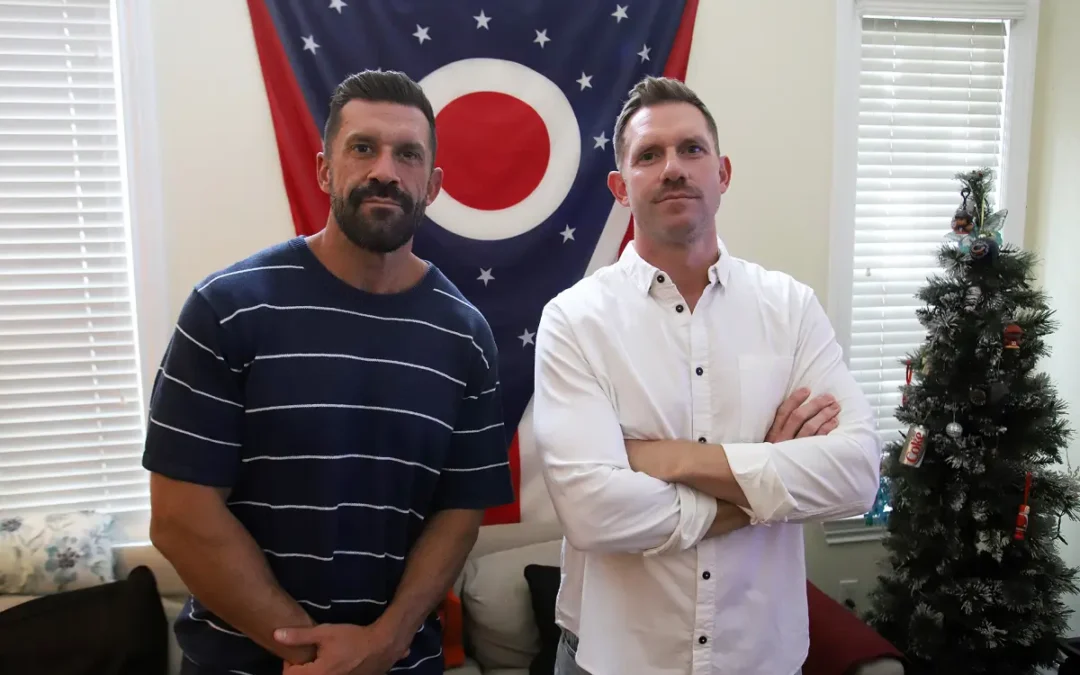
Ohio House co-founders Brandon Stump, left, and Ryan Stump recently won a battle with Costa Mesa over the right to do legal business after 14 years of operating in the city.
(James Carbone)

Ohio House runs a recovery program in five single-family homes on Costa Mesa’s East Wilson Street.
(James Carbone)
Their decision ended a showdown that went all the way to the U.S. District Court and was the subject of numerous appeals before the Costa Mesa Planning Commission and a petition before the 9th Circuit Court of Appeals.
At every turn, rulings sided with the city, which had rejected granting licensure to the Ohio House because another recovery center already existed within a 650-foot distance buffer established in Costa Mesa’s sober living ordinance for multifamily properties that was enacted in 2015.
Pleas from the Ohio House — operating since 2012, well before local laws were put in place — fell on deaf ears as the city’s legal team stood firm. Ryan Stump said he and his brother had no choice but to fight for an enterprise they claim has changed the lives of hundreds of grateful clients.
“The way this unfolded we felt there was no other way for us to continue operating other than take legal recourse,” he told The Pilot. “We had no choice but to stand for our residents, families and the 1,000-plus years of sobriety of those who have come through those Ohio House doors.”
Ohio House is born
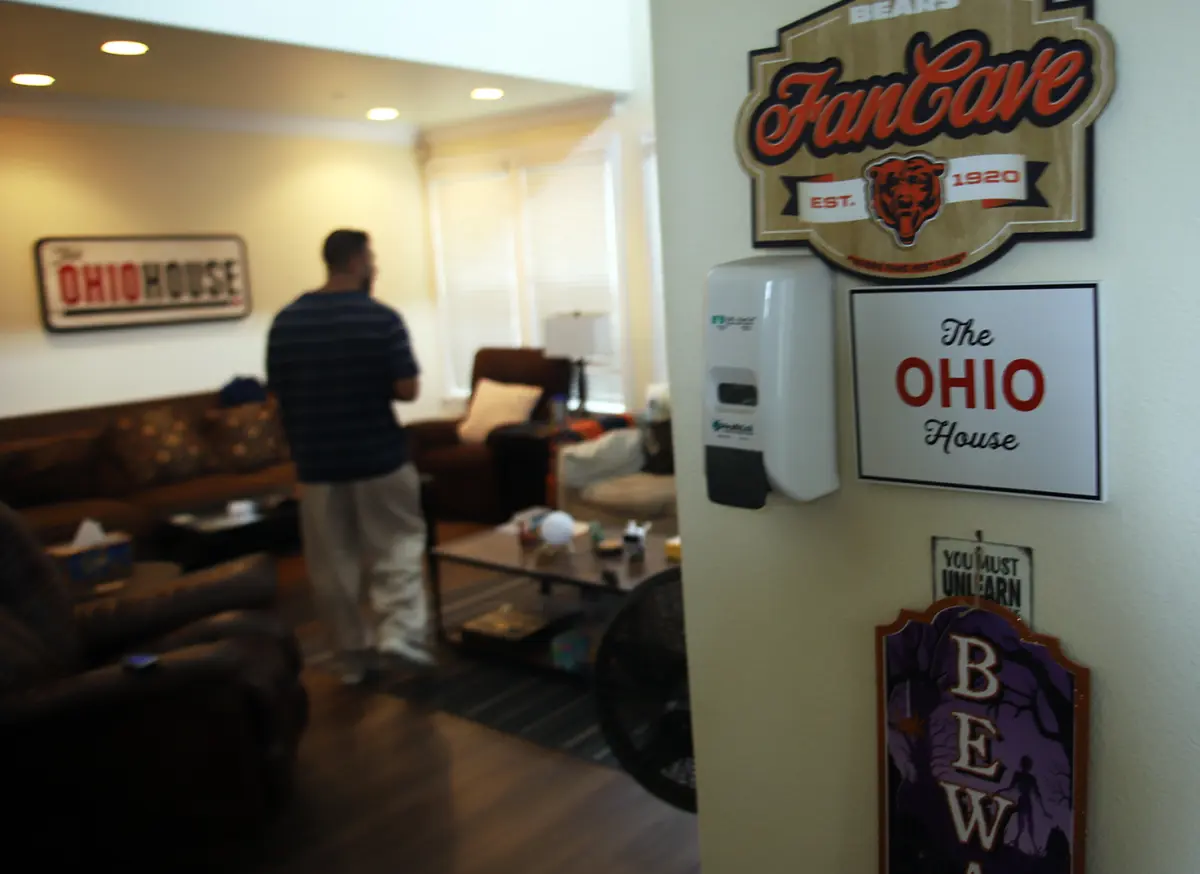
Brandon Stump, founder of the Ohio House visits one of the the sober living homes in Costa Mesa Thursday.
(James Carbone)
Brandon Stump was 23 when he moved from Ohio to California in 2008 in an attempt to get sober. He thought leaving his environment would be enough, but soon realized the problem was within himself. The journey was difficult as he tried detox programs of all kinds, ultimately achieving sobriety in 2010.
That same year, he went back home for Thanksgiving, where friends still struggling with addiction marveled at the change they saw in him.
“A few of them reached out for help, so I told them, ‘Move to California and I’ll show you what I do to stay sober,’” the Costa Mesa resident recalled. “I moved them into my house at the time; people jokingly called it the Ohio House, because it was just three guys from Ohio staying sober.”
That homespun approach, through trial and error, morphed into a treatment program centered on rules, routines and accountability. Brandon Stump later enlisted help from Ryan, who had a corporate background and could handle the legal, administrative side of the business, while Brandon worked front of house.
“I have experience with addiction, so I’m the one talking to people in-house and inspiring them to stay sober,” he said. “He’s operational; I call him the glue. We would never have gotten through this if it was just me or just him.”
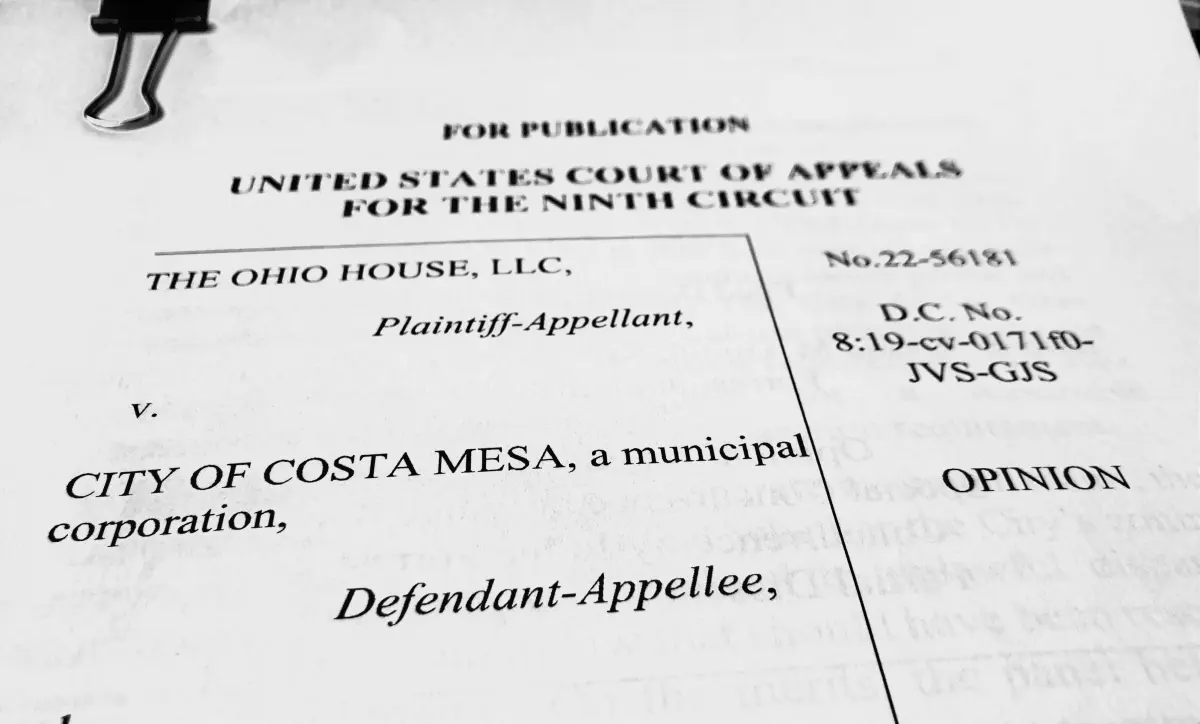
In a 2024 legal opinion, a panel of federal appeals court judges contended Costa Mesa was within its right to create and enforce regulations around the operation of group homes and to deny permits to Ohio House.
(Sara Cardine)
Caught in the crossfire
The Ohio House operated without major incident for several years. Meanwhile, other sobriety-centered group homes and rehabs began to proliferate in Costa Mesa, bringing institutional uses to residential areas. By 2013, a reported 200 facilities had sprung up.
Concerns about overconcentration, outfits discharging unsuccessful clients onto city streets and impacts from parked cars, excessive cigarette smoking and noise spurred city leaders to draft regulations, first in single-family neighborhoods in 2014, then for multifamily residences the following year.
“It’s time to make a stand,” then-Councilmember Wendy Leece said during a July 2014 meeting. “We need to have our own city structure and not assume that the sober-living operators are giving that structure.”
The laws mandated permits and required operators to submit house rules, intake procedures, relapse policies and to affirm residents, due to their addiction, qualified as handicapped under state and federal law.
Ryan Stump said code enforcement teams had initially engaged in a dialogue with the Ohio House, indicating the facility could help the city achieve a desired outcome with the ordinance. But that never happened.
“We were left in the dark with the exact timing of the ordinance taking effect and what would be required of an applicant,” he said.
By the time Ohio House applied for permits in 2016, another state-licensed facility 550 feet away, at 165 E. Wilson Street, had already been approved. With a 650-foot separation requirement firmly in place, Ohio House was dead in the water.
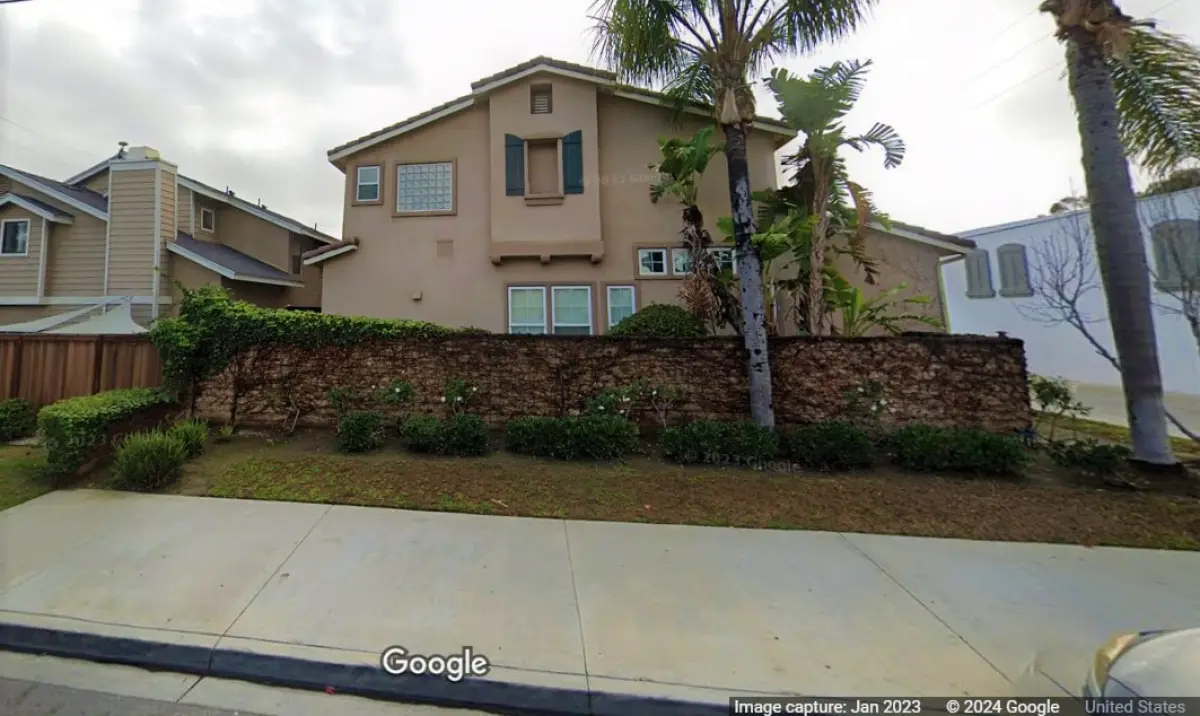
The front-most house on a five-residence lot at 115 E. Wilson Street in Costa Mesa that has served as a sober living facility called Ohio House since 2012.
(Google Maps)
A turning tide
Undeterred, the Stumps in 2017 began seeking reasonable accommodation from the mandated buffer, claiming Ohio House clients were disabled and, as such, protected under the law. That same year, the city had implemented such an exemption.
But, still concerned about an overconcentration of sober living homes, the city denied those requests. Appeals to the Planning Commission failed, while state and federal appellate courts sided with Costa Mesa in 2022 and 2025, respectively.
But the tide began to turn. State-level offices, from the attorney general to the Civil Rights Department to Housing and Community Development (HCD) began reviewing the Ohio House matter with a new gaze.
An HCD officer in a June 8 letter to Costa Mesa maintained the city’s sober living laws violated fair housing laws protecting individuals with disabilities, including addiction. The officer cited a 2023 letter from the same department recommending the ordinance be repealed entirely.
Rather than going that route, the city opted to reconsider the Ohio House’s reasonable accommodation request. Brandon Stump said it was the first time he and his brother were able to have a sit-down conversation with Costa Mesa officials.
“It only took nine years for that to happen,” he said.
Finding common ground
During the Oct. 20 City Council hearing, Ohio House clients testified to the life-saving strategies employed at the Wilson Street facility.
“I always felt like I was never enough,” said Chad Steinetz, a client from 2017 to 2019. “When I arrived at the Ohio House, it was the first time since I was a kid I felt like I was enough and I belonged.

Ryan Stump, left, and Brandon Stump, co-founders of the Ohio House, were recently granted a conditional use permit for the sober living facility they’ve run since 2012.
(James Carbone)
“It’s more than just a group home, it’s a place where people have the opportunity to transform their lives and make this community around them better. I wouldn’t be alive if it wasn’t for these guys — I wouldn’t have anything.”
The council voted 7-0 in favor of the Stumps’ conditional use permit. Councilmember Jeff Pettis, spoke about his own recovery from addiction 20 years ago, and how transitioning to a sober living home helped him.
“Had I not gone through that experience, I would not be here,” Pettis said. “We need [this] type of programming in the city. I applaud you and thank you — please keep doing what you’re doing.”
Brandon Stump described his elation after the hearing.
“More than anything, there was this overwhelming feeling that everything we had been through had finally meant something, relief that we could finally put this behind us and get back to focusing on what we started the Ohio House for in the first place — helping people rebuild their lives.”
In a joint statement issued Friday by the city and Ohio House, officials described the two parties working in an “interactive process” to reach a mutually agreeable decision.
“Due to the many changes which have occurred since Ohio House first sought permits in 2017, we recognize that this location, which has been operating for years without complaints from neighbors, is in a unique location which allows for an accommodation to be provided from the strict interpretation of the City’s rules,” Mayor John Stephens said in the statement. “We are pleased that through a collaborative process, the City and Ohio House have been able to reach an agreement to end years of litigation.”
Updates
7:21 p.m. Oct. 30, 2026: This story has been updated to include information from a joint statement provided by the city of Costa Mesa and operators of the Ohio House.

Sara Cardine
Staff Writer, LA Times
Sara Cardine covers the city of Costa Mesa for the Daily Pilot. She came from the La Cañada Valley Sun, where she spent six years as the news reporter covering La Cañada Flintridge and received a first-place Public Service Journalism award from the California News Publishers Assn. She’s also worked at the Pasadena Weekly, Stockton Record and Lodi-News Sentinel, which instilled in her a love for community news. (714) 966-4627